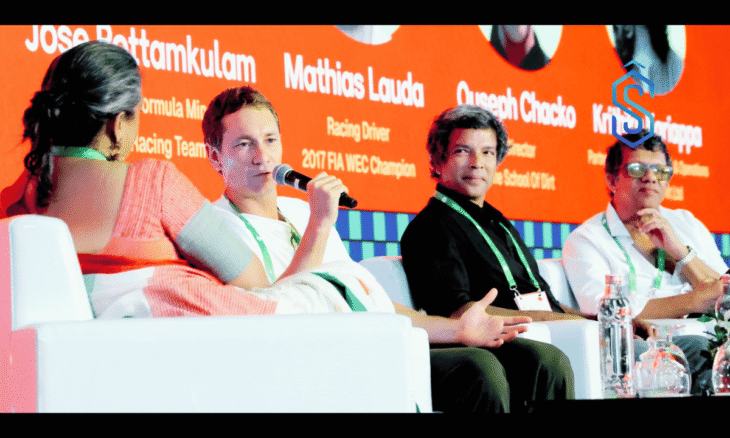
Thiruvananthapuram: Can competitive motorsport become accessible to aspiring racers without requiring families to spend crores of rupees?
Kerala-based startup M&N Racing Team is working on a new racing car concept designed to lower the financial barriers to entering professional racing, with backing from Mathias Lauda, son of legendary Formula One champion Niki Lauda.
The startup aims to develop a racing car that bridges the gap between go-karts and Formula 4 (F4) cars, creating a more affordable stepping stone for young drivers looking to enter competitive motorsport.
The concept is being developed in Kerala, while the proposed vehicle will be manufactured in Europe using Italian technology.
Through this initiative, M&N Racing Team wants to address one of the biggest challenges facing aspiring racers globally: the escalating cost of progressing through the motorsport ladder.
The project was unveiled during a panel discussion at Huddle Global 2026, organised by the Kerala Startup Mission (KSUM) in Kovalam.
Mathias Lauda, who has joined the venture as a partner, spoke about the growing financial burden of competing in F1 feeder series and how the economics of motorsport have changed over the years.
“It was expensive even when I entered the F1 world in the early 2000s. It has gone up much more,” he said.
Lauda’s association brings international motorsport experience to the Kerala startup’s initiative, which seeks to create a more structured and affordable pathway for aspiring racing drivers.
M&N Racing Team Wants to Bridge the Gap Between Karting and Formula 4
At the centre of the M&N Racing Team project is a proposed racing car positioned between go-karts and Formula 4 vehicles.
Currently, young drivers looking to build professional racing careers must progress through different levels of competition, with each stage involving substantial financial commitments.
The transition from karting to higher-level racing can be particularly expensive, limiting opportunities for talented drivers who do not have access to significant financial resources.
Jose Pottomkulam, founder of M&N Racing Team, described the initiative as an attempt to take motorsport innovation from Kerala to international markets.
“While others are working to bring the world of F1 races to India, we want to take this idea to the wider world,” said Pottomkulam, popularly known as Ootta.
The project is intended to tap into motorsport talent across the world while creating a structured development route for aspiring racers. Safety and professional development are also expected to be central to the proposed ecosystem.
By introducing a racing category between karting and Formula 4, M&N Racing Team hopes to make the transition to competitive motorsport less financially demanding.
Rising Motorsport Costs Shutting Out Young Racing Talent
The financial challenges associated with professional racing were a key theme during the Huddle Global 2026 discussion.
Lauda, who began his racing journey in his twenties, highlighted how the high cost of participation can prevent talented youngsters from entering the sport.
Ideally, aspiring professional drivers need to start at a much younger age to progress through the competitive racing ecosystem.
However, the expenses involved in developing a racing career make an early start difficult for many families.
Pottomkulam highlighted the cost difference between various stages of racing, particularly in India and international markets.
According to him, an aspiring driver in India may need to spend around ₹25 lakh for a season of go-karting. Moving from karting to Formula 4 can cost approximately four times as much.
“In Europe and the US, expenses can be around 10 times higher,” he said.
Such costs mean that motorsport careers are often accessible primarily to families with substantial financial resources.
Pottomkulam noted that only wealthy families can typically afford to support the expenses associated with professional racing.
Lewis Hamilton, who came from a working-class background, remains a notable exception in a sport where financial backing often plays a significant role in determining who gets an opportunity.
The M&N Racing Team initiative seeks to address this accessibility challenge by introducing an alternative racing platform between karting and Formula 4.
However, Pottomkulam said additional funding would be required to move the initiative into its next phase.
He added that Lauda’s association was expected to provide a significant boost to the project as it works towards developing the proposed racing car and taking the concept forward.
Ecosystem Offers Opportunities for Technology Companies
The discussion at Huddle Global 2026 also examined the broader opportunities emerging from motorsports and associated technologies in India.
Ouseph Chacko, director of School of Dirt, highlighted the growing popularity of motocross and pointed to the opportunities available for Indian technology companies in the sector.
He said the motorsport industry could create opportunities for Indian companies to develop products and solutions for the global racing ecosystem.
This extends the potential of the sector beyond professional drivers and racing teams to companies working on automotive technologies and related products.
Chacko and Pottomkulam also highlighted the enthusiasm among young people, particularly those attracted to the speed and excitement associated with competitive racing.
Krithika Kariappa of M&N Racing Team, who moderated the discussion, noted that the large number of questions from the audience reflected growing interest in motorsports in Kerala.
Lack of Racetracks Remains a Challenge
While affordability was a major focus of the discussion, the panelists also highlighted the lack of dedicated racetrack infrastructure in India as a significant concern.
The absence of proper facilities and safe racing venues limits opportunities for young motorsport enthusiasts to train and compete in controlled environments.
Speakers pointed out that when legal and dedicated racing facilities are unavailable, some youngsters turn to illegal road racing, exposing themselves and other road users to the risk of accidents and fatalities.
The panelists stressed the importance of developing dedicated racetracks where young enthusiasts can learn racing skills, receive professional training and participate in competitions safely.
They also called for government intervention to develop the infrastructure required to support the growth of motorsports in India.